Your cart is currently empty!
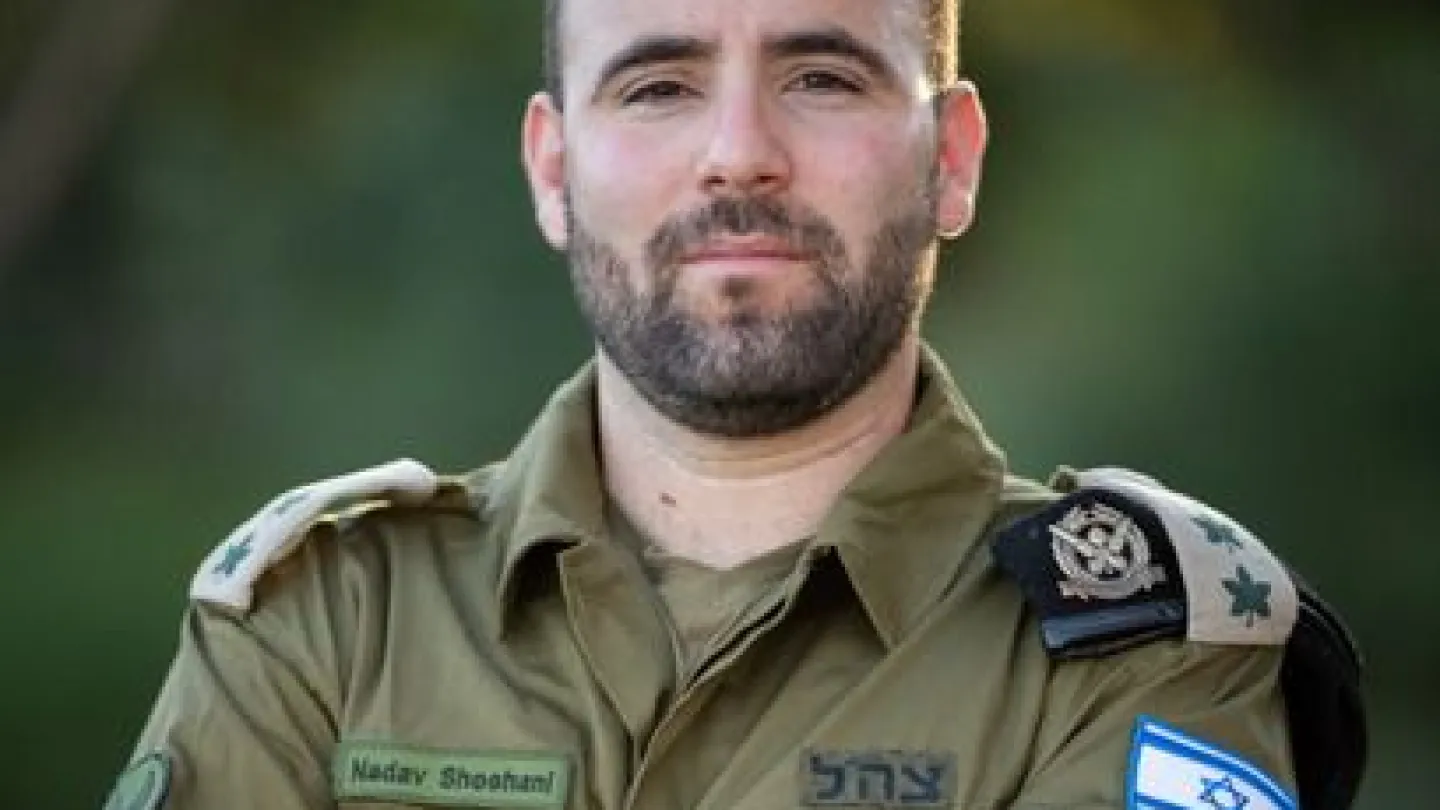
‘Iranian regime is weakest it’s been in all my years of service’
It is difficult to imagine a more intensive time to serve as the Israel Defense Forces’ international spokesperson than the past two years, the period in which Lt. Col. Nadav Shoshani has held the position.
Shoshani will, in the coming days, complete his role, and he shared observations with JNS on a two-year period marked by significant challenges—both in the military and media arenas—alongside major strategic gains for Israel.
Since assuming the position in April 2024, amid ongoing conflicts on multiple fronts, Shoshani has explained to numerous international media outlets the evolution of Israel’s security situation, its many challenges, and navigated the complex minefield of global public opinion and social media disinformation.
Looking back at the time when he took up his position, Shoshani told JNS in a recent interview, “Hezbollah was still a monster on our border. The entire northern Israel was evacuated. In Gaza, Hamas was controlling most parts of Gaza. We had most of the hostages still in Gaza. Iran was moving forward as an existential threat much, much, much stronger than now. We had threats from Syria. The Assad regime allowed a comfortable ground for Iranian terror on our border. And Israel was in a war on all fronts. The Houthis were firing at us and holding a maritime siege … the Iraqis were firing at us.”
However, fast-forwarding to the present, more than two years later, Shoshani stressed the dramatic improvements. Most notably, “for the first time in over a decade, there are no Israeli hostages in Gaza.”
He also highlighted the weakening of Israel’s adversaries: “The Iranian regime is probably the weakest it’s been in all my years in military service. The threats emerging from Syria towards us are enormously diminished.”
While acknowledging Hezbollah remains a threat, he noted they are “nothing compared to what they were two years ago.”
These military successes have re-established Israel’s position as a regional power. “Israel in the last two years has shown our high capabilities, has shown how essential we are for security in the region and in fighting off terror in this region,” Shoshani stated, adding that Israel has moved “from a place where it was at its weakest to a place right now where Israel is looked at as one of the strongest forces in the Middle East.”
Despite these operational achievements, Shoshani acknowledged a corresponding rise in global antisemitism, fueled by hostile propaganda that demonizes the Jewish state and its self-defense actions.
“A can of worms that has opened up globally, with different actors giving the light of day for antisemitic attacks against Jews,” he said, adding, “It is much safer in Israel for Jews. Sadly, it is much less safe for Jews around the world than it was two years ago.”
A significant portion of this global challenge stems from the media environment, particularly social media. Shoshani pointed to social media as “the main pushing force of antisemitism, of fake news against Israel.” He criticized the lack of accountability among influencers with millions of followers who “have no editorial process, have no commitment to the truth,” and noted that some are even “promoted by money and bots from foreign countries.”
This dynamic places the IDF in a defensive position on the information world stage. “We do communications, we don’t do propaganda or information wars,” Shoshani explained. He cited instances where IDF actions in areas infested with terrorist adversaries have been reported in international media outlets with “zero mention of what happened in those villages for the last 40, 50 years.”
The fast-paced nature of social media creates a persistent tension between speed and accuracy, he added. Shoshani highlighted the difficulty of debunking false claims, explaining that proving something did not happen requires extensive verification across various units and commands.
“Proving someone didn’t shoot in a certain location—you have to make sure that you go over all the types of soldiers in the area, air force, artillery, ground forces,” he said. “Standards are different when it comes to the Israel wars, where people use information coming from groups that are known as designated terror groups.”
He recalled specific instances of egregious disinformation, such as an Al Jazeera report claiming the IDF used “bombs that evaporate people.” Such baseless claims “spread on social media like wildfire,” forcing the IDF to publicly address them. He also recounted a case where Gazans dug mass graves, only to blame the IDF later, despite video evidence proving otherwise.
“The truth sometimes doesn’t matter. People still want to put an image out and say this is the story and they don’t really care about the truth or the facts.”
A particularly concerning trend identified by Shoshani is the exploitation of journalism by terror operatives. “We’ve seen terrorists using the guise of journalism as protection for their operations,” he stated. This tactic is part of a broader strategy in which terror organizations “will use medical staff, ambulances, schools, kindergartens, a press vest, whatever they need to promote their operations.”
Shoshani emphasized that the failure to properly note that terrorist operations are embedded within civilian infrastructure emboldens these groups. “As long as the headline that breaks is IDF bombs the school, Hamas and Hezbollah see that and say, ‘great, mission accomplished,’” he argued. He noted that the ultimate victims of this strategy are civilians in Lebanon and Gaza, as the terror groups “have immunity to try and kill Israelis from within these complexes.”
Addressing the broader regional context, particularly Iran, Shoshani described the IDF’s recent operations during Operations Rising Lion and Roaring Lion as having damaged the Iranian regime in “a significant way that will mean stability for a prolonged period of time.” He highlighted the IDF’s unprecedented capability of achieving full aerial freedom of operation over Iran, a feat that “two years ago would sound like science fiction.”
The future of the conflict depends on the Iranian regime’s actions in supporting terror or potentially reengaging in uranium enrichment, Shoshani said.
“We will not budge on the fact that we have to protect the civilians of Israel,” he stated.
Concerning the solidarity of Jewish communities worldwide with the IDF, Shoshani added, “There’s an enormous significance to the support the Jews give to the State of Israel and to the IDF. It is the wind that pushes us forward, and it is part of our strength.”
Leave a Reply
You must be logged in to post a comment.